Introduction
Executing a comprehensive ISO 27001 Gap Assessment is the single most critical milestone for any organization aiming to validate its information security management system (ISMS). In today’s interconnected digital landscape, data security isn’t just an IT concern—it’s a foundational pillar of business trust. For fast-growing technology companies, managed service providers, and cloud-native enterprises alike, achieving the gold standard of information security means aligning closely with international frameworks.
However, staring down the complete list of mandatory clauses and the revised 93 Annex A controls can feel overwhelming. Where do you even begin? The answer lies in understanding exactly where your security posture stands today compared to where it needs to be. By identifying the voids in your current policies, technical infrastructure, and employee workflows, you can build a precise, cost-effective roadmap straight to compliance.
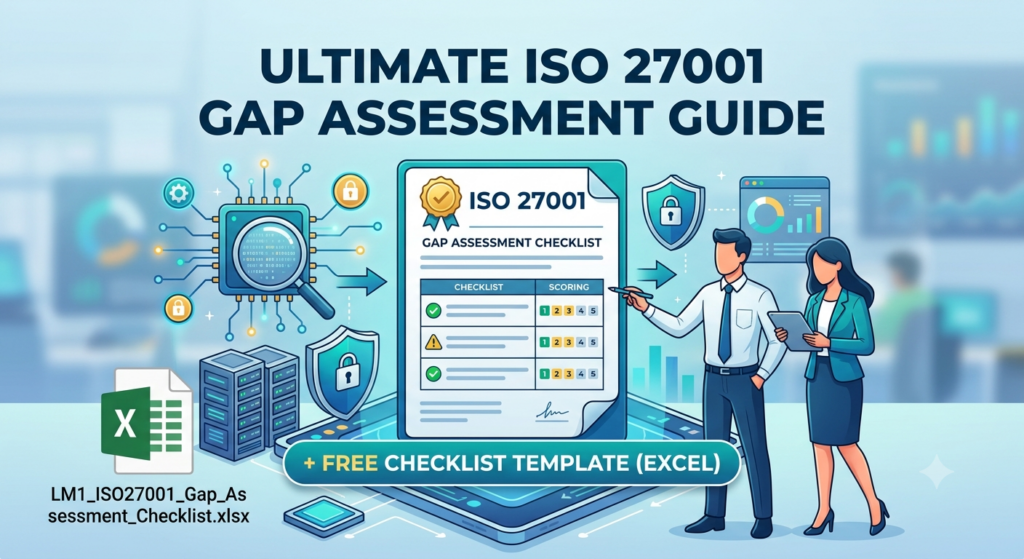
To help you kickstart this journey seamlessly, we’ve developed an actionable framework alongside an invaluable downloadable tool: the LM1_ISO27001_Gap_Assessment_Checklist.xlsx. Let’s dive into how you can use a structured gap analysis to demystify compliance, satisfy rigorous external audits, and bulletproof your infrastructure against modern cyber threats.
What is an ISO 27001 Gap Assessment?
An ISO 27001 gap assessment is a comprehensive evaluation that compares your organization’s existing information security management practices against the formal requirements of the ISO/IEC 27001:2022 standard.
Think of it as a strategic health check for your Information Security Management System (ISMS). Instead of guessing which security controls you lack, a gap assessment gives you definitive, empirical evidence.
[Your Current Security Baseline] ----> ( The Compliance Gap ) ----> [ISO 27001 Certification]The assessment covers two distinct dimensions specified by the standard:
- The Core Clauses (Clauses 4 through 10): These dictate the management framework, leadership commitment, risk treatment processes, resource allocation, and continuous improvement metrics.
- Annex A Security Controls: The updated 2022 framework organizes 93 granular security controls into four key domains: Organizational, People, Physical, and Technological.
Why a Gap Assessment is Your Most Critical First Step
Skipping straight into drafting security policies without running a formal ISO27001 Gap Assessment is a recipe for wasted time, redundant software spending, and organizational frustration. Here is why prioritizing a formal assessment saves resources:
- Optimized Resource Allocation: Why spend thousands of dollars deploying a new endpoint detection platform if your existing infrastructure already meets the objective? A gap assessment stops you from reinventing the wheel.
- Accurate Budget and Timeline Forecasting: Executives always ask: “How long will certification take and what will it cost?” A thoroughly completed gap audit provides the exact data needed to answer that question confidently.
- Streamlined Risk Management: ISO 27001 is fundamentally a risk-driven framework. Your gap findings feed directly into your risk assessment matrix, aligning technical security with overarching business objectives.
Step-by-Step Guide to Conducting Your ISO 27001 Gap Assessment
Step 1: Define Your ISMS Scope
Before looking at a single control, you must define the boundaries of your management system. Are you securing the entire organization, a specific geographic office, or a single SaaS product offering? Documenting your scope ensures your assessment doesn’t suffer from continuous scope creep.
Step 2: Gather Your Core Stakeholders
Compliance is not a solo sport for the IT team. You will need to interview owners across various departments:
- Human Resources (for background screening and onboarding controls)
- Legal & Compliance (for regulatory and regulatory contract obligations)
- DevOps/Engineering (for secure coding, access control, and change management)
- Facilities/Operations (for physical security perimeters)
Step 3: Run the Requirements Matrix
Evaluate your current state against each requirement by asking targeted, practical questions. For example, when assessing Clause 4.1 (Internal & external issues), ask your leadership team: “Have we formally documented the political, economic, legal, and technological factors that present a risk to our sensitive data?” For external verification on shifting compliance landscapes, you can review the latest updates directly on the Official ISO Standard Portal.
Step 4: Score and Document Findings
Assign an objective readiness score to each requirement. Document the concrete evidence of implementation (or lack thereof), assign an owner, specify the priority level, and establish a firm target completion date.
Inside the Free ISO 27001 Checklist
To make this execution phase as straightforward as possible, we have packaged our internal compliance framework into a ready-to-use spreadsheet: LM1_ISO27001_Gap_Assessment_Checklist.xlsx.
This interactive workbook features a dedicated sheet titled Gap Checklist designed to score your compliance journey from start to finish. It utilizes a structured 1-to-5 scoring index to help you map out your exact posture:
| Score | Implementation Status | Meaning |
| 1 | Not Started | No framework, policy, or technical control exists for this item. |
| 2 | Planning Only | Discussions have occurred, but no active implementation has begun. |
| 3 | Partially Implemented | Controls are active in some areas but lack consistency or documentation. |
| 4 | Mostly Done | Minor gaps remain; policies exist but need optimization. |
| 5 | Fully Implemented & Evidenced | Control is highly mature, operating consistently, and fully backed by evidence. |
Conclusion & Next Steps
Conducting a thorough ISO 27001 gap assessment is the most reliable strategy to eliminate guesswork, secure executive buy-in, and build a definitive, auditable blueprint for your business security. Instead of looking at compliance as a stressful administrative obstacle, treat it as a strategic optimization project that hardens your infrastructure against modern cyber threats.
Don’t start your compliance journey staring at a blank page. Take control of your organization’s security alignment today by leveraging a proven, field-tested tool.